Florence Spaven, our new Heritage Conservation Project Officer has been out on site at Brignall joining in with our volunteers. Florence has a buildings conservation background and little experience of archaeology but we thought it would be useful for her (and hopefully enjoyable) to get some hands-on experience with what the others in the office do.
She has kindly been writing a blog of her experiences (See Days 2 and 3 for earlier entries). Over to Florence...
Week 2 got off to an excellent start with a few new volunteers joining our group. In Trench 1, the team were able to begin excavation of some of the visible features, having completed the cleaning, photographing and planning. High on the list of features to excavate were the large patches either end of the trench – which had been visible on the geophysics – so volunteers got underway excavating these. They very quickly encountered a number of large rocks, seemingly the infill of a large ditch forming the circular feature observed on the geophysics. A number of other features were excavated, including an area in the central portion of the trench, which revealed a number of post-holes. As I write this today – Wednesday, after my hard slog in my slightly less exciting ditch (see below) – it seems that there is a further circular ditches within the larger one. This, along with a number of excavated post holes, and some further suspected ones, indicates that this may have been domestic rather than funerary. This possibility fits in with some Neolithic/Bronze Age pottery found in the Trench, particularly in a section of smaller stones which may be a path or surface. In fact, there has been very little medieval pottery from this trench. Seemingly, our ‘Shrunken Medieval Village’ could be much, much older. Watch this space for further news on Trench 1 as the team continue to investigate!

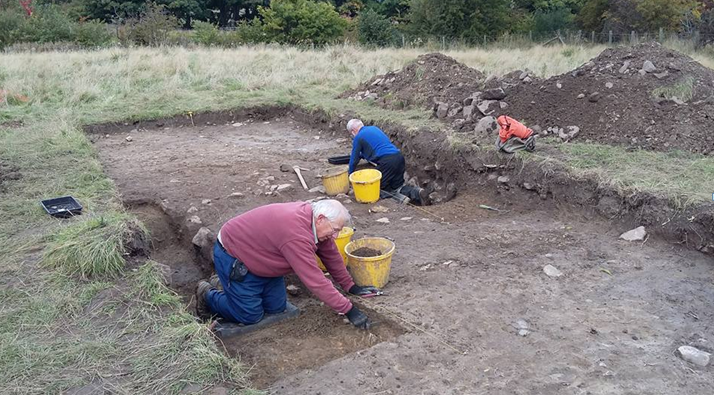 Excavating and recording the ring ditch in Trench 1
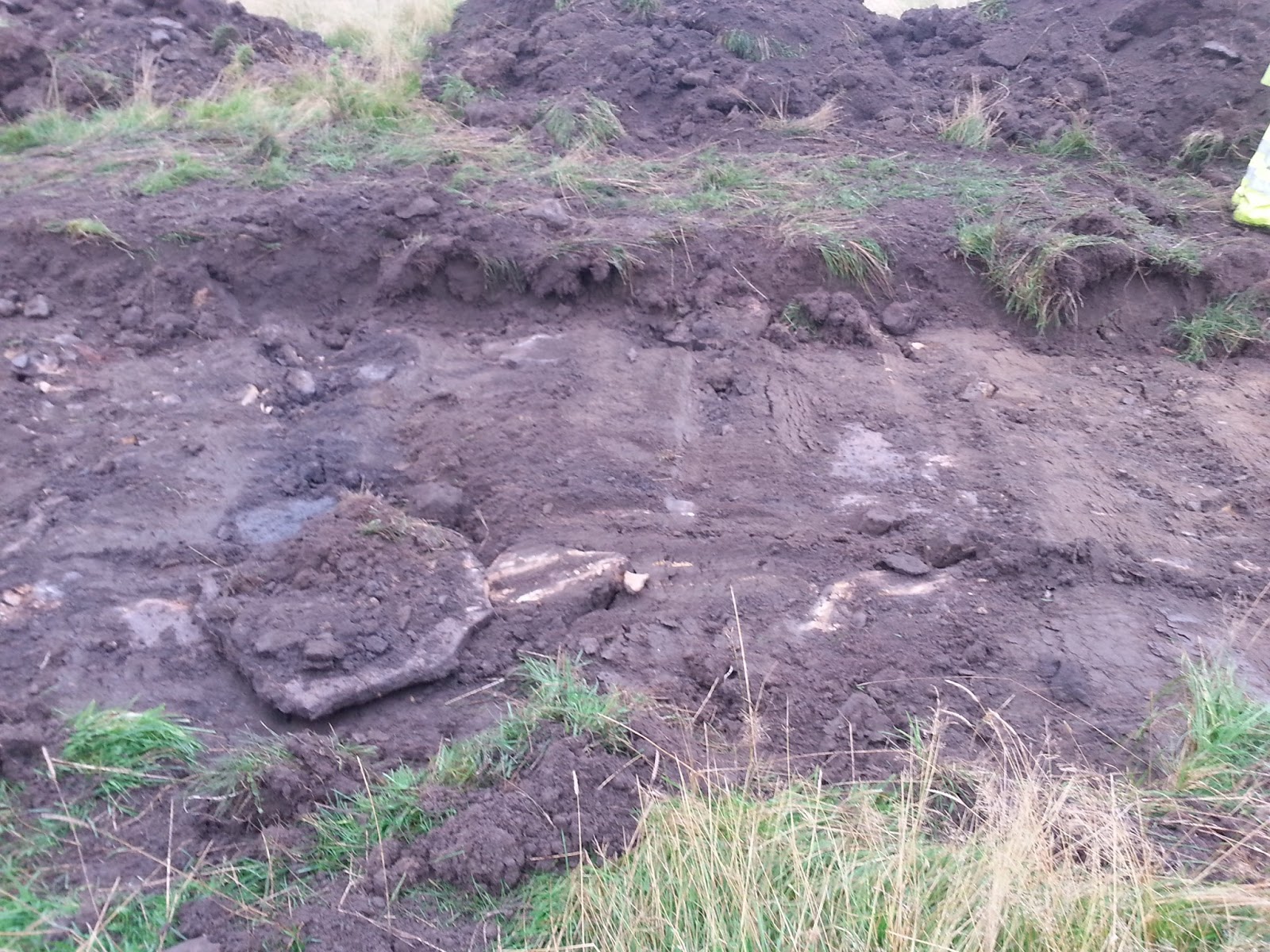
Trench 2 is also becoming quite exciting (apart from the ditch I’ve spent this week digging, although I am hopeful something fantastic awaits at the bottom). The row of large flagstones we had crossing the trench at one end have prompted much debate. Are they part of a medieval kitchen floor? Are they covering a culvert? These are particularly interesting because either side of them are further stones. On one side, a section of smaller stones – possibly a surface for a yard or path – has been exposed. To the other side, there is a row of large stones, seemingly forming the foundation to a wall. The first of the large slabs came up today, following thorough recording, and there is no culvert to be seen. However, there is a visible different in the soil underneath, so hopefully by the end of this week, we’ll have a better idea of what this could have been. The other leg of Trench 2 has a number of features, and a few of these have now been excavated. So far, Al (the archaeologist supervising this trench) has concluded that these are largely (wait for it) ditches, from some time, which have been infilled, at some point in time. Although this may sound much less exciting than the discoveries I’ve already talked about, these ditches must still be excavated and recorded. They may also prove to be very useful in understanding the medieval – or possibly earlier – village as a whole. For instance, the large ditch I’ve been excavating along with another volunteer this week appears to be the end of a ditch as it doesn’t cross right over our trench. If this is the case, it may indicate where people historically passed into and out of the property relating to the building we’ve got at the other end of the trench. If we find anything, such as pottery or bone, which can be dated, we can also find out when these ditches were infilled. So, these ditches may be as interesting as the other things we’ve found.
 Cobbled surface in Trench 2.

She has kindly been writing a blog of her experiences (See Days 2 and 3 for earlier entries). Over to Florence...
Week 2 got off to an excellent start with a few new volunteers joining our group. In Trench 1, the team were able to begin excavation of some of the visible features, having completed the cleaning, photographing and planning. High on the list of features to excavate were the large patches either end of the trench – which had been visible on the geophysics – so volunteers got underway excavating these. They very quickly encountered a number of large rocks, seemingly the infill of a large ditch forming the circular feature observed on the geophysics. A number of other features were excavated, including an area in the central portion of the trench, which revealed a number of post-holes. As I write this today – Wednesday, after my hard slog in my slightly less exciting ditch (see below) – it seems that there is a further circular ditches within the larger one. This, along with a number of excavated post holes, and some further suspected ones, indicates that this may have been domestic rather than funerary. This possibility fits in with some Neolithic/Bronze Age pottery found in the Trench, particularly in a section of smaller stones which may be a path or surface. In fact, there has been very little medieval pottery from this trench. Seemingly, our ‘Shrunken Medieval Village’ could be much, much older. Watch this space for further news on Trench 1 as the team continue to investigate!
Trench 2 is also becoming quite exciting (apart from the ditch I’ve spent this week digging, although I am hopeful something fantastic awaits at the bottom). The row of large flagstones we had crossing the trench at one end have prompted much debate. Are they part of a medieval kitchen floor? Are they covering a culvert? These are particularly interesting because either side of them are further stones. On one side, a section of smaller stones – possibly a surface for a yard or path – has been exposed. To the other side, there is a row of large stones, seemingly forming the foundation to a wall. The first of the large slabs came up today, following thorough recording, and there is no culvert to be seen. However, there is a visible different in the soil underneath, so hopefully by the end of this week, we’ll have a better idea of what this could have been. The other leg of Trench 2 has a number of features, and a few of these have now been excavated. So far, Al (the archaeologist supervising this trench) has concluded that these are largely (wait for it) ditches, from some time, which have been infilled, at some point in time. Although this may sound much less exciting than the discoveries I’ve already talked about, these ditches must still be excavated and recorded. They may also prove to be very useful in understanding the medieval – or possibly earlier – village as a whole. For instance, the large ditch I’ve been excavating along with another volunteer this week appears to be the end of a ditch as it doesn’t cross right over our trench. If this is the case, it may indicate where people historically passed into and out of the property relating to the building we’ve got at the other end of the trench. If we find anything, such as pottery or bone, which can be dated, we can also find out when these ditches were infilled. So, these ditches may be as interesting as the other things we’ve found.
The dig is continuing until the 23rd October, so if you’ve been thinking about coming along, hopefully this news
persuades you to do so! We start at 9.30am every day (apart from Sunday).
Saturday will be an open day (from 10am until 3pm), and anyone is welcome to
come along, either to dig, or to have a look at what has been uncovered. Please
come along!
Thanks Florence. Sadly we have to bring Florence back into the office next week (we can't do without her) so she will miss out on the last week. Thanks for all your help Florence.

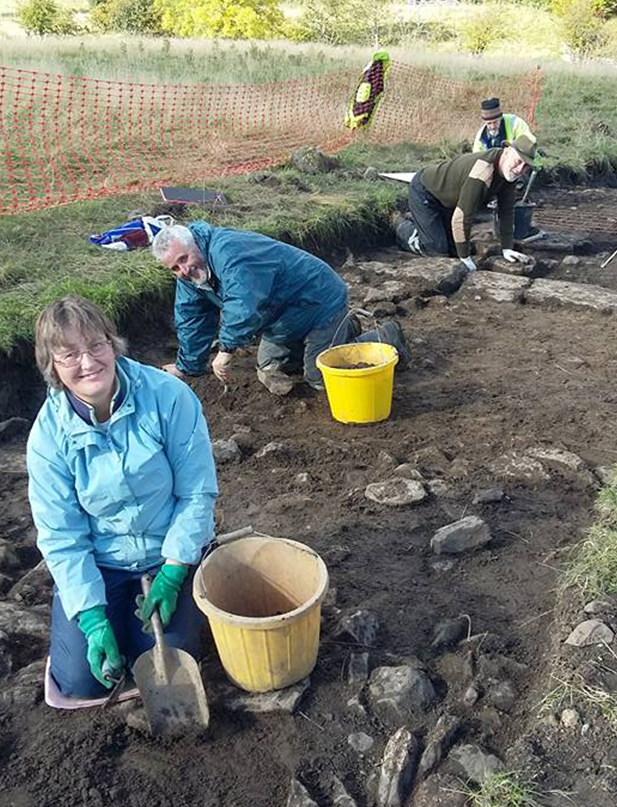
Getting a taste of the muddier side of our work, Florence with Trench 1 supervisor, Martyn Cooper.